7.28.2006

Wilderstein: Blissfully skipping its way into irrelevancy

During the week leading up to Memorial Day, my mother and I had a corresponding day off and decided to welcome the new season with a day trip down to the Hudson Valley.[i] Our goal was to visit some of the historic houses that the region is so famous for; since we had both already made visits to the larger houses (I wrote an article a while back on my observations of the FDR house), we went a bit more obscure.

Eventually, we found our way to Wilderstein, a mansion in Rhinebeck that up to recently (1991) was the home of the Suckley family. Similar to many Hudson estates, Wilderstein was built in the Victorian Period (1852) by a wealthy businessman who had married into the Livingston Family, the ultimate patriarchs of the Valley's aristocracy. As a student of history and former professional historic interpretor, I enjoy visiting historic sites, not only for the joy of learning history, but also to see how they go about the always difficult task of public interpretation; the purpose of this essay is to pick apart not the history of Wilderstein, but the modern use of the building and land by the not-for-profit Wilderstein Inc.
Three generations of descendents of the founder dwelt in the house living lives that were basically filled with aimless diversion and substanceless fluff. One might think that I am being a bit harsh, but being student of the history of wealth and power in Victorian New York,[ii] I have no illusions that the majority of the wealthy individuals of that era 1) inherited their wealth and 2) squandered it 3) while doing virtually nothing to contribute to society and 4) exacerbating through their spending habits the suffering of the poor throughout New York and the world at large. From all that I can see, the Suckleys were no different from the Vanderbilts and other robber barons, if at a lower level of extravagance.

The final inhabitant of the house was Margaret "Daisy" Lynch Suckley, a cousin, close friend and possible lover of Franklin Delano Roosevelt. Daisy inhabited the house from birth to death, 1891 to 1991, just missing her 100th birthday by a few months. She, like 5 of her 6 siblings never worked, married or bore children [iii]. During her ownership the beautiful mansion decayed almost to the point of destruction due not to lack of wealth but either to incredible eccentricity or a simple inability to function economically enough to organize the repairs; perhaps both. Great attention is given in Wilderstein today to Daisy, to the point of perfectly preserving her kitchen as she left it on the day of her death (post-it notes and Burger King Buffalo Bills glasses included). They give special empahsis to her relationship with FDR and the fact that she gave the President his famous dog, Fala.

My aim in this essay, however, is not to condemn a woman who has passed on and was raised in what I am sure was a socially stifling and stunting lifestyle, but instead to talk about Wilderstein Preservation, Inc, the non-profit started by Daisy that preserves her house. To lay out my interaction with the organization, I have taken the Wilderstein tour, perused the website and looked through their public collection, thus I have no greater knowledge that would be available to the general public.

The tour at the site was a disappointment. To its credit, the house is a beautiful one inside and out and the restoration work is impressive. Likewise, our tour guide[iv] was enthusiastic, knowledgeable and personable. The substance of the tour, however, was incredibly shallow, focusing almost entirely upon Daisy. When I tour
a place like the homes of FDR or Harriet Tubman, I expect the guide to give me the story of that person's life and how that house is a reflection of their life. However, Wilderstein is no Mount Vernon and it and its last owner are little more than historic footnotes, ancillaries to the FDR story downriver in Hyde Park. Quite frankly, I don't care too much about Daisy and I think I'm safe in saying that the majority of the public agrees with me.

Whenever historic interpreters focus solely upon an individual and his or her family history,[v] regardless of who the person was, they ignore the greater stories that the site can tell. What tales does Wilderstein have to tell about Victorian tastes or life? How is it a reflection of greater Hudson valley elite society and how is it unique? How does the genteel life of earlier periods affect life both for modern aristocrats and us ordinary folk? What statements or ideas are conveyed by the architecture of the buildings? How is the decorative craft-work or practical tools within the house typical or a-typical of the era, what effect did they have on the history of decoration or home-life in America? Why were most of the furnishings imported from Europe and what implication was there to the small amount of American furnishings one could find? One of the family members died in WWI, how was the Hudson Valley aristocracy affected by that war? What was servant life like, where did the servants come from and how did the house interact with the surrounding communities? There are so many questions that were completely unapproached in the tour, questions that could have told a story that was more interesting and meaningful to contemporary observers.

Beyond simply the tour, the greater organization seems unable to burst out of its fetishistic fascination with Daisy. Granted, the theme this year is "Daisy," but all of the events at the house surround her or the glorification of the aimless type of life that she lived (for instance the "Daffodil High Tea" and the Venetian-style "Red Ball"). There are no events exploring the broader history or context that the site, supposedly one of the few purely Victorian sites in the region. Furthermore, the organization supposedly has an incredible collection of clothes, documents and objects from the Victorian era, but seems ignorant of how to use them. There are, for instance, no events for costume designers or historical artists to have sessions looking over the period clothes or chances for photographers or historians to publicly look through the tens of thousands of photos. Granted, the archives are open to researchers, but besides this passive acceptance, there is no effort taken to utilize their archives.

To put up a contrasting site, let me divert your attention to Mount Gulian, which is downriver at Beacon. A historic house run by a small non-profit, Mount Gulian has seen a great many events including Revolutionary War battles, the founding of an important fraternal organization (The Society of the Cinncinatus) as well as daily life amongst the wealthy from the Colonial Era through to the Victorian Era. Mount Gulian, however, recognizes that it is not one of the "big" sites and instead focuses its attention locally and in putting its place in context. They have a variety of interesting and informative events; for instance, they had a discussion of the role of food in Dutch still life painting followed by a meal where the participants ate Dutch colonial foods. They are rebuilding the formal gardens for education and recreation. They have community events for children and adults, including a Revolutionary War day camp and storytelling events. The site interprets not only the history of the wealthy family, but also their servants (including a freed slave), pre-colonial Wappinger Indians and its context in Colonial and Revolutionary society. Mount Gulian is a somewhat older non-profit than Wilderstein, but also had a long and costly restoration project on its hands (Mount Gulian in fact burned down to its foundation in 1931) when it started. I feel that it is an excellent example of what Wilderstein could still become and, in doing so, be far more useful to society and its local community.

Wilderstein Preservation Inc, according to Natalie (who knows about these things) is currently struggling and I see no relief from problems given their current course. They focus upon a woman and a dog (Fala) whose memory, importance and relevance fade with every year that we move away from the FDR administration. At the same time, more and more of these historic houses are moving into the public hands in the region, creating ever increasing competition for tourist dollars. If the house continues to refuse to branch out and challenge greater questions, have a more diverse offering of events and bring the community in more, I foresee only more problems. In fact, I see that it, like Daisy before it, will slowly fade away giving little to the local community and doing little but watch the beautiful house decay.

-By Jesse

[i] Quite ironically, we were right in Natalie's neighborhood, going so far as to drive by her house once, but she was attending an event out of state and missed our visit.
[ii] I was a tour guide and later tour supervisor and assistant curator at Sagamore, a Victorian-period Vanderbilt mansion in the Adirondacks for three seasons where I helped to design tours, train tour guides and research/develop new permanent exhibits.
[iii] Let me clarify this, near the end of her life, she did spend a few years working as a curator at the FDR Library but apparently out of a dedication to the President and a personal love of archival work.
[iv] A volunteer
[v] As a tour guide and participant I have long stood by the statement that the only genealogy most people care about is there own (and sometimes not even that) and family trees should be kept to minimum on
tours.
Images from the Wilderstein Preservation website

7.25.2006

A Flood Story from the Southern Tier

Editor's Note: Since several people have been asking for "flood coverage," and neither Natalie nor I live in the effected areas, I asked my mother if she would put down a few thoughts of her own about the terrible June-July floods in the Binghamton area. She graciously agreed to help out and sent me this post the other day. I hope that it helps those who live in the rest of Upstate and areas beyond to understand the plight of my homeland and the strength that people can find within themselves and each other when the chips are down. -Jesse

I woke up very early on the morning of Wednesday, June 28 to torrential downpours just like it had been doing for the last three days, with Broome County being in a State of Emergency due to the flooding. I turned on the tv and was stunned to see a filmclip, which was shown nationwide, of a house in from the Conklin area, that had been knocked right off its foundation by a gas explosion into the river and was floating downstream.
I received calls all day long from my family and friends with updated reports on the roads being closed and the waters approaching their homes. I offered my home, up on a hill, as a sanctuary to a few families that were quite concerned that day. Evacuation shelters were set up, one at the high school my sons went to. This was day one of the flood.

The second day, I went into work, in downtown Binghamton. I was told to evacuate by 8:30 a.m. as the flood walls, just a few blocks away, were leaking and officials were afraid that they would collapse and the downtown area would be awash with dirty muddy sewage-filled waters. By that day, I started getting reports of people I knew who had water in their first floor homes. One basement was filled with water and when it receded thru the foundation, a large fish was found swimming around!!!
Day two was the day that I noticed that the local Gander Mountain, Toy R Us, our local Johnson City park and an adjoining neighborhood was covered with about 7 feet of water from a small little creek running behind it. I wondered "where did all this water come from? It was a tiny creek"

By the third day, many helicopters were flying over my property. Local events were being cancelled and centers were set up for food and clothing collection. By then we knew the water treatment plants were flooded as were the sewage treatment centers. Raw sewage was not only in the river, it had entered into many people’s homes. By now, the waters had receded in some areas and one can see the layer of mud covering everything in its path.

On July 4 my husband spent the day tearing out soaking wet, moldy carpeting and linoleum from a relative’s house, while I volunteered at the Emergency Disaster Relief Center in Binghamton. I heard first hand, at this center and from people I know at work the following days, what it was like to wake up at 2:00 a.m. and hear the river break out every window in your home and gush into your house. I heard how, even though people in the village of Deposit were cut off from the world for 5 days, houses and businesses flooded, no electricity, roads closed, no cell phone coverage, no outside relief…how they banded together and helped one another until they could be helped.

My former co-worker’s basement was completely flooded, her mother’s home is condemmed and she lost everything. The water sat in her home for 3 days without receding. She was told, once it receded that she could enter her house on a limited basis for only two days to retrieve items. After that the black mold would be a major health problem and the wooden floors would begin cracking. The trailer park down the street from her had trailers pulled right off the ground and flushed down the river, as were a few homes that were pulled right off their foundations and moved by the force of the water. And still, with all this devastation to her hometown and her family, she and her firefighter husband loaded up trucks and trucks of food and water and spent about a week delivering these needed items to people that "were truly in need".
At the relief center, I sat and listened to the people who lost everything. By that time there were no tears. It was more of being in a state of disbelief. They talked of being so terrified by the violent waters, that they couldn’t even grab their wallets, nor car keys to drive away. They literally jumped out of bed and ran out of their homes. As my son mentioned in one of his postings, there was an elderly man who came up to my table, barefooted, and asked where he could get shoes. And this was 6 days after the flooding. There was a young mother who asked if anyone had any diapers for her baby.

There were others that had spent days and days cleaning out the mud and sewage out of friend’s basements and were worried about disease. Many people came looking for cleaning kits that the Red Cross and Salvation Army were providing. Others, when I asked if they needed such a kit, responded that there entire house was so filled with mud and a mop and sponge wouldn’t help.

I remember a woman who owns flooded apartment buildings; she took in all her tenants in her own home and came into the relief center to see if she could receive some assistance in feeding all of them. The gas station next door to the apartment dwelling never recycled their oil from oil changes. These barrels were knocked over by the waters and the oil spread into the apartments. The landlady said she can see, on all the apartment windows, where the oily water reached. The buildings are condemmed because of it.

Then there were the trailers and homes that exploded due to natural gas and propane problems.
I sat next to the DMV table and I saw the blank looks when people came to them, asking how they can handle their "lost cars" and they were told they needed to provide a car title and pay a $15 fee. These people lost everything, including all important papers. How can they prove which car belonged to them?

I also noticed one young couple come to the center, only to get very upset and overwhelmed and storm out. Others, had little books where they kept lists and lists of things they needed to do in order to rebuild their lives again. It seems so overwhelming to go thru all that red tape in the best of times, I can’t imagine doing it under such stress.

All the people I saw, no matter how distraught they were, were all so very thankful. And the volunteers I saw were incredibly compassionate. I was truly touched and it still brings tears to my eyes how people in this community reached out to strangers.

The media coverage in this area was excellent. But it just does not compare to actually sitting and listening to people talk about how their lives have been completely destroyed within seconds.

I had read and heard how Susquehanna High School in Conklin, the hardest hit town in this area, was the drop off for all the debris from the damaged homes in that area. There were mountains and mountains of moldy, wet, muddy items that were hauled to the dump.

Tonight, on the way home from a friend’s house in this area, I drove down a few roads near the river. This is 2 weeks after the flooding. Many of the homes have been condemmed and marked with a huge red X near the front door. It is shocking to see it. It just does not seem real. Can you imagine looking at your own home, having it marked as such and realizing that you can never enter that building again?

Each of these condemmed buildings still had piles of, what looked like dirty rubbish, piled in front. On closer view, I realized that the "junk" were once someone’s treasures. Now they are thrown near the road, to be picked over by scavenger people (yes, they are out in force).

The mental health counselor who was stationed next to me at the relief center had experience "at Katrina", as did the many Emergency Disaster Relief personnel from the Red Cross. I asked this counselor what she could possibly tell the flood victims to bring them some emotional relief. Besides the usual words, she mentioned that these people lost their identity. They lost their heritage and the sense of who they are. We surround our living quarters with memories and symbols of where we came from, who we are and where we might be going to. Whether you live in a small trailer, a basement apartment or a lavish house, your home is the place you go to, to feel secure. It is the place that is truly an outlet of who you are as a unique human being.
This is what was lost for the many flood victims. One can replace refrigerators and clothing. But it is the sense of identity that will be the most difficult to reclaim.

My heart goes out to each and every one of flood victims. And I look at awe and deep admiration at the many many people in the Broome and Tioga Counties who have stopped their own lives to help those in need.

-by Kathy

7.24.2006

A Journey to Beaver River

Beaver River, the Adirondack town and river, had a brush with annihilation by the creation of Stillwater Reservoir some years ago. Beaver River (the river), imprisoned behind earthen walls, swelled upwards and flooded much of Beaver River (the town). However, it was not the flooding of buildings that threatened to do the town in, but the fact that two miles of the only road connecting her to the outside world was now deep under water.

Normally, this isn’t a problem-you just cut a new road- but Beaver River was unique that it was surrounded on all sides by water or the New York Forest Preserve. Since it is illegal, technically “unconstitutional,” to cut trees on the Forest Preserve (they are “Forever Wild”), Beaver River (the town) was now hemmed in.

Somehow, Beaver River adapted and has survived the years. Primarily a seasonal vacation-home settlement, the “Happy Hermits of Beaver River” (as a old news article proclaimed them) appear to prefer their isolation. The only access is by boat, in particular the car ferry Noridgewock, or through an isolated wilderness trail leading from Twitchell Lake. It was this trail that I and my friend Joe took last Saturday, an exodus through the wonders of the nature world, both biological and legislated wilderness, to one of the most bizarre artifacts of the Adirondack Park.

Twitchell Lake is itself an obscure destination. To get there requires one to drive an hour and a half north of Utica on rural Route 28 and then for one to turn left at the abandoned brick building in Eagle Bay, then to travel some further miles to the turn-off for Twitchell Road. Twitchell Road continues for some miles, eventually becoming a dirt road that ends at a beautiful lake and a DEC trailhead.

We arrived at the trailhead in the pouring rain, just as the only other group to risk exploration of the lake on that day retreated via kayak to their cars. However, we looked on the bright side because, as true Adirondack hikers, we knew that rain meant no deer flies. In truth, the movies in neither Inlet nor Old Forge were appealing and we couldn’t handle any more rustic furniture shops, so the trail was the only real option for that day.

The upper trail sign read: “Trail to Beaver River 7.5 miles” and the one below: “Trail to Razorback Pond 2.5 miles.” A rather wide dirt trail extended into the dripping forest. I told Joe I was pleased to have no fern-overgrown foot track, since those are absolutely miserable in the rain, as it’s impossible to avoid getting your legs and boots soaked. About a half-mile later, our trail-a fern overgrown foot track-turned away from the broader trail to Razorback Pond. As we came to accept the fact that we were going to get wet, the trail climbed steeply out of the Twitchell Valley and my mind turned to the land around me.

For readers not overly familiar with the Adirondack Park’s inner workings, a bit of explanation is necessary here. On most maps, the Park appears to be one great green mass, like a giant balloon tied to NYC by the thin rope of the Hudson River. In truth, however, it is far more complex than that and the plain green belies a “crazy quilt” of regulation and ownership.

Unlike every other of New York’s 306 state parks (except the Catskill Park, which was created with the same legislation), the State does not own the entire Park. In fact, it does not even own the majority of the land within the Park’s boundaries; however, with each passing year, new acquisitions bring the Park closer to the 50/50 balance called for in the State Land Master Plan (SLMP). Those lands that the state does own are classified by the all-powerful SLMP into several types of districts.

The strictest classification is Wilderness. These 16 districts include the Pigeon Lake Wilderness, through which my sodden trail was cut. Within a wilderness area, not only is the cutting or salvage of timber permitted (and this is banned on all state lands in the Park), but so is the use of all motorization. In statutory wilderness there are no ATVs, snowmobiles, chainsaws, bicycles, float planes, unicycles, generators or other such totems of civilization, even for the DEC forest rangers. Last year up here in the Park, I assisted the local forest rangers in a search-and-rescue operation in the Blue Ridge Wilderness Area; we proceeded in canoes and on foot. Granted, the waterways were too tight for motorboats and the trails too narrow for ATVs, but the DEC still follows its own rules in this regard. Roughly half of the Forest Preserve is designated wilderness.

Each of the other classifications allow for greater and greater intensity of human use: “wild forests” allow for motorized transportation, “intensive use” areas are DEC-run campgrounds and ski areas, “canoe areas” are like wildernesses but allow for some motorized maintenance by the DEC, etc.

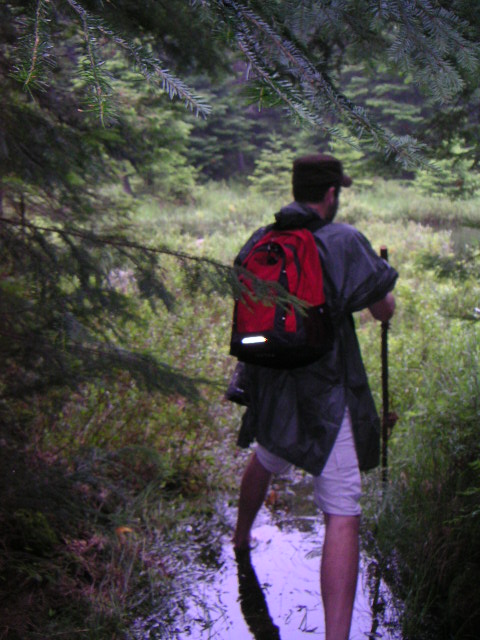
What effect does the presence of the Pigeon Lake Wilderness have upon Beaver River and my own journey? For one, our little town finds itself surrounded not only by Forever Wild State land, but by the most isolating, heavily protected public lands in the world. For me and Joe, it meant that in the back woods there were no bridges, steps, graded trails or conveniently placed benches. At one point, it was necessary for me to wade up to my mid-thigh through a stream, carrying my pants and shoes around my neck as I picked out invisible stepping-stones under the golden-brown water. As if we weren’t wet enough.

The land around Beaver River is not, however, “true” wilderness, by which I mean lands untouched ‘by the hand of man.’ The vast majority of the Adirondack Park (some 95+%) were logged during the past 150 years, some places several times and relatively recently. The core of the Forest Preserve came from lands that had been completely cut over and then abandoned by timber companies in the late 1800s- eventually reverting to state possessions when the owners defaulted on their taxes. The forest preserve is littered with the sites of mansions of the wealthy, mines, ghost towns, fire towers, mills, children’s summer camps and hunting camps; it is certainly not without the ‘hand of man.’

Beaver River itself sits next to a huge lake that is completely the creation of human hands. The Pigeon Lake wilderness contains one former children’s camp that I know of (on Cascade Lake) and I’m sure many other structures. A road to nowhere, the ‘Six Mile Road’ cuts through it and ends at the flooded shoreline. In a wider sense, there is no place on Earth, through climate change, extinctions, acid rain, etc, that is not affected by the hand of some man or another. There are no wolves, elk or cougar in Pigeon Lake, but they certainly were there before the hands of white men came in.

Yet, for some reason, the State and advocates of statutory ‘wilderness,’ in the Adirondacks and beyond, continues this charade. They go so far as to destroy “non-conforming structures,” AKA anything that belies the true nature of this supposedly untouched lands. In doing so, not only have they created Beaver River, but also the philosophic ideal of wilderness itself.

By isolating 16 parcels of a remote forest as being forever closed to motorboats and chainsaws, they have simultaneously given carte blanche for the rest of the world to be open to them. By saying that “here is nature and it is precious, bow before it,” they are turning a blind eye to everywhere else as tainted and unnatural.

But in fact, nature does not end at the edge of the wilderness. The trees that grow in the Wilderness of Pigeon Lake are indistinguishable from those in the Hamlet of Beaver River, or the City of Utica for that matter. Aren’t the homes of Beaver River built of wood and stone and metal, all natural sources? Isn’t the food we eat, the water we drink and the air we breathe nature? When nature is though of something wild and separate from our experience, we deny part of our own existence and the nature of our own homes.

The paradox of Beaver River, trapped on one side by man’s desire to capture and harness wild nature for progress and industry and on the other by the spiritual desire to protect those havens of wild nature forever from the hand of man, is apparent immediately as you push out of Pigeon Lake and onto the dirt road next to “Al’s Hut” (as Al’s sign reads) and look out over the artificial lake. It is a short walk through densely packed vacation houses to the heart of the hamlet.

The remaining 50% of the Adirondack Park is privately owned; it is, however, uniquely zoned according to building density by the Adirondack Park Agency. Just as public lands are “wilderness,” “wild forest” or whatever, private lands are zoned into categories ranging from “hamlet,” which has an unlimited building density, to “resource management,” which allows one building per 32 acres.

Beaver River is one of over 100 hamlets in the Park, which is obvious from the high density of structures in a tiny box of land around a small lagoon. The centerpiece of what is more-or-less an individually-owned resort is the Norridgewock III, the “complete resort.” While the building is, according to the waitress, actually the fourth Norridgewock hotel, we were more concerned with dry feet and hot meals than truth in advertising. I can unhesitatingly recommend the Norridgewock kitchen, with the caveat that all food tastes better after hiking. I had the “tree hugger” (veggie burger) and found the “special sauce” to be delicious and perfect for disguising the inevitable blandness of the faux-flesh; wouldn’t it be funny if it had meat in it?

And so, with stomachs full of hot food and cold beer, our feet somewhat drier and our shoulders rested we made the return trip. In fifteen miles and about seven hours we had traveled through the heart of the wild and into the Adirondack equivalent of ecologically forsaken land. It was a bizarre, damp and enjoyable afternoon.

By Jesse

7.19.2006

Dog Politics in New York: Fighting the Medusa

By Mahlon Goer

The New York State regular legislative session ended on June 23, and elected NYS representatives packed their bags and hightailed it for their home districts. No time for long good-byes here in Albany, as New York State Senators and Assemblymembers have people to talk to and places to be. That’s because November elections are just around the corner.

But what you didn't know is that New York State legislators left behind a big, steaming, unsightly pile of you-know-what for dog owners, and it won’t go away so quickly.

A BIG Pile of You-Know-What

That big, steaming pile of crap I'm referring to is a big pile of dog laws.
This year - there were 100 proposed bills on dogs & pets. There were no less than 70 - count 'em folks - that's 70! proposals on dogs PLUS another 30 on pets (including dogs).

Now NY was the first state in the union to require dogs to be licensed, way back in 1894, and today New York has one of the most comprehensive sets of dog laws in the country.

Article 7 of the NYS Agriculture and Markets law, aka “Licensing, identification, and control of dogs” is huge. Its humongous.

Its so big, and so complex, that the helpful people at the New York Council of Mayors and Municipal Officials had to actually circulate a cheat sheet on the NYS dangerous dog portion alone. If elected officials charged with administering the law have a tough time finding their way through it, imagine the trouble the average dog owner has with it.

Can You Feel The Love?

Get a load of what dog-owning New Yorkers had to wade through - the giant load (pun intended) of dog bills by those NY legislators (who feel it necessary to leave their mark) submitted during the 2005-06 legislative session:


· Twenty-two (22) proposals on dangerous dogs

· Fourteen (14) on dog breeders
· Thirteen (13) on dog licensing
· Six (6) proposals on dog groomers
· Two (2) guardianship bills
· Two (2) highly restrictive “anti-tethering” bills
· Two (2) dogs-in-open-vehicles bills
· Two (2) dogs-in-closed-vehicles bills
· Two (2) bills mandating surgical removal of doggy gonads and endocrine systems
· One (1) bill which invents the mental illness of “companion animal hoarding”, and promptly makes it criminal
· One (1) mandatory microchip and widely accessible “dog database” bill
· One (1) bill banning the surgical removal of doggy tails and ear flaps
· And a partridge in a pear tree--

Oh, wait! Sorry, wrong list.

Democracy In Action?

Somehow, despite all of these proposals on dogs, I’m just not feeling the love of freedom and justice shining down on me from Albany. Are the 43% of New Yorkers that own dogs especially blessed with all these proposals to further regulate and restrict them? I don’t think so.

Its more like watching legislators throw (you-know-what) proposals at the wall, hoping something will stick.....

And some legislators make making dog laws practically a career!

Dog Law Frequent Flyers

NYS Assemblymember Michael Benjamin of the Bronx:

During one busy week in March, 2005, Asy. Benjamin submitted three dog law proposals. Then one more in April. And then yet another one in June. We won’t even discuss how many more he partnered on with other legislators.

Call me crazy, but I’m thinking Asy. Benjamin’s constituency would love to see some of that energy devoted to other things. Like helping them cope with rising fuel costs. Asy. Benjamin's district reports some of the lowest median incomes in the nation. Why is trial-ballooning statewide dog laws such a big part of Michael Benjamin's agenda?

NYS Senator Carl Kruger, of Brooklyn:

In a freak accident, a small dog sadly died at a pet grooming facility in his district in June 7th, 2006. By June 16th, Senator Kruger had drafted and submitted a bill calling for pet grooming facilities across the state to be comprehensively regulated.

Impressive! If only legislators could work that fast to stop child abuse, or pass a budget. But what happened with the bill? Well, Senator Kruger’s proposal joined the other five on pet groomers already before the state legislature. But, hey, it’s the thought that counts, right?

Stop The Madness!

The truth is that with very few exceptions, we have plenty of dog laws in New York. Really. Like the snakes growing out of Medusa's head - there seems to be an endless supply of proposed dog laws that dog owners must battle in every legislative session here in New York.

Addressing real problems is tough. Its hard work. Incredibly hard work. It can't be done in front of TV cameras, despite what they told you in Albany.

Is Your Dog A Cheap Date?

Legislators looking to add a feather in their caps can whip up a quickie dog bill, and then woo the dog-owning public - which is about half of us - just in time for mid-term elections. And if that makes you feel like a pawn on a larger political chessboard, you would be right.

Well, I’m here to tell you: I’ve been taking names. When November elections roll around, politicians who misdirect the public from real and pressing concerns and instead focus on yet another unnecessary or poorly considered dog law won’t get my support.

My dog votes! And when my dog looks at that long, long list of pending legislation in New York, he shakes his head and wonders what the heck is wrong with humans, and who he's gonna vote for.

Mahlon Goer is a founding member of the Dog Federation of New York, Board Member and Regional Legislative Coordinator, American Dog Owners Association. A published author and frequent commentator on dog issues, Mahlon lives in the Hudson Valley region of New York with her husband, daughter, and Cuba --who consistently votes the dog ticket. This post and discussion about it can be found on Dog Politics. For more information on Dog Laws in NY, visit the Dog Federation of New York blog.


Editor's Note: Submissions to York Staters on any Upstate topic are alway welcome. York Staters will be on hiatus Wednesday afternoon through Sunday, as Co-editor Natalie will be visiting Co-editor Jesse in the nature-and-culture-rich (but internet-poor) Adirondacks. Expect comment approval, new posts, and tales of excitment come Monday.

7.18.2006

Summer in New York: Grey Fox Bluegrass Festival

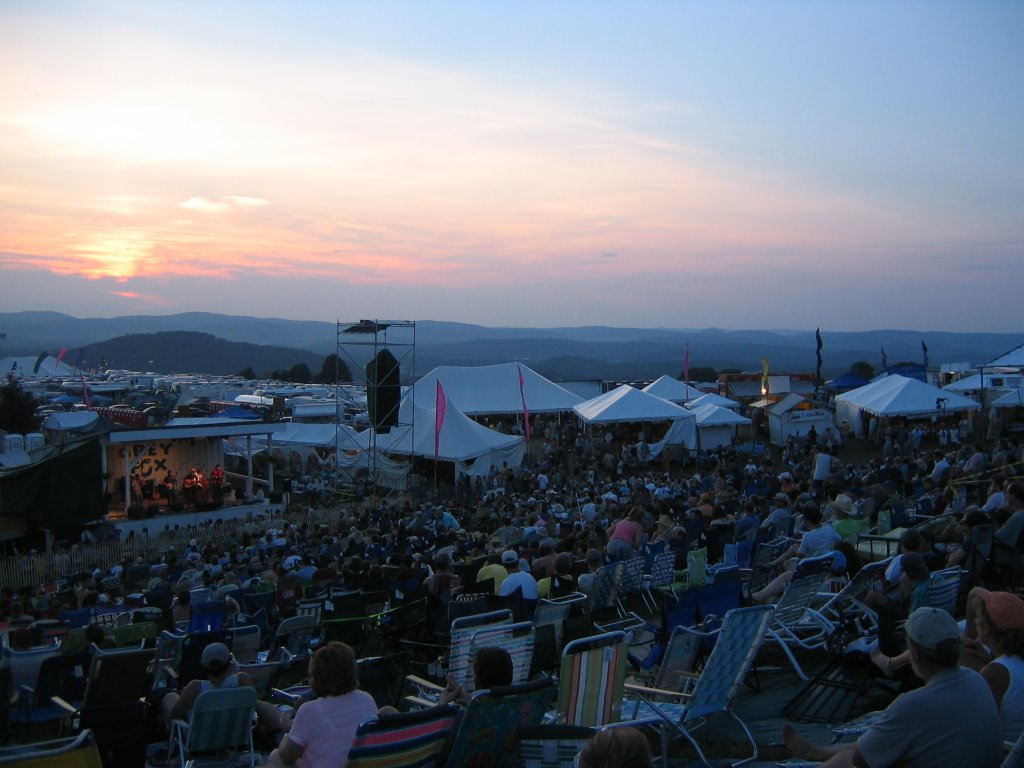
Celebrating its 30th anniversary, the Grey Fox Bluegrass Festival took place this past weekend on the Rothvoss Farm in Ancramdale, Columbia County, attracting bluegrass fans from all over the state and eastern seaboard. I was lucky and got in for free helping my friend Will table for excellent independent radio station WKZE where he works (if you're in the Mid-Hudson Valley, check them out at 98.1 or listen online from anywhere) The photo above was taken at sunset Friday night, and you can see both the excellent turn-out and the beautiful rolling Berkshire foothills. In addition to the main stage above, there were a couple smaller stages, vendors, activities for the many musically inclined children in attendance, and a lot of really nice folks, many of whom camped out on the hill during the four day festival. (You can buy tickets for the whole weekend or just for an individual day of the festival.)

If you missed it and you can't wait until next year for some upstate bluegrass action, you're in luck! Grey Fox has a sister festival: The Fox Family Bluegrass Festival in Old Forge August 10 - 13th.

Posted by Natalie

7.17.2006

Summer in New York: Robert H. Treman State Park

Summertime in New York State offers many opportunities for fun, even if you're stuck under the flourescent lights from 9 to 5 as I am. Many exciting things are just a drive away.

Robert H. Treman State Park
When you are a small child, this park is the most magical place ever (though come to think of it, it feels that way when you're an adult as well) My family and I come to this park every year, and the natural beauty of the hiking trails and unique swimming area never ceases to amaze.

Located in the towns of Enfield and Newfield just outside of Ithaca, Robert H. Treman Park has plenty of what the Ithaca area is known for: hippies.
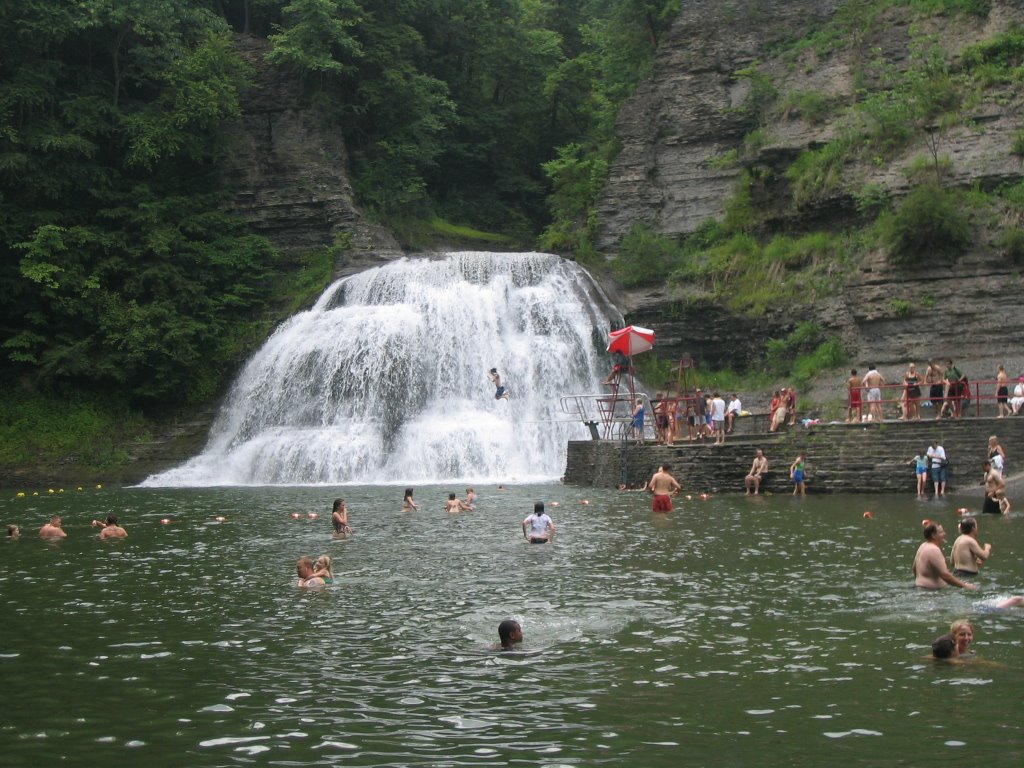
No, seriously, it has an abundance of gorges and waterfalls. The one pictured here you can swim up to and sit on the natural rock shelves as the spray falls on you. The day we went was only shortly after the recent period of torrential rain, and the waterfall was quite forceful (and cold) but enjoyable nonetheless.

There are two entrances to the park, the lower entrance that leads to the swimming area and camping area (where you can pitch a tent, bring an RV, or rent a cabin) and the upper entrance with plenty of great picnic spots and access to the trails and upper waterfalls, including the 115-foot Lucifer Falls. The camping and swimming areas are very accessible, but some of the hiking is not for the faint of heart. More geological and historical information is available here. Well worth a visit....it might just become a favorite summer destination for you too.

Posted by Natalie
See also: The Parks of New York

7.13.2006

Hostels, Backpackers and Trains- A future for tourism Upstate?

The state of hostelling and backpacking in America:

Today on CNN, I read an article entitled “US Hostels struggle to live up to European Counterparts;” the gist of the article was that European hostel culture, emphasizing community, interaction and the backpacking lifestyle has never taken hold in the United State. To quote:

“Wander through any major European city and you're bound to stumble upon dozens of hostels, their doorways crowded with rucksacks and chatting, laughing backpackers. The cheap, dormitory-style lodging and lively social scene are fixtures for European travelers on a budget…

But they've never quite caught on across the Atlantic. Numbering about 10,000 worldwide, there are only about 350 hostels in the United States, according to Hostelling International-USA. The few available suffer from a lukewarm reputation, a transportation system that doesn't favor backpackers and -- perhaps the most fatal flaw -- anonymity.

The representative of Hostelling International (HI) sums up the hostel culture: “the whole idea of internationalism and achieving peace through travel.” In America, however, it seems that hostels only represent the cheapest of indoor accommodation. One of the key components of hostelling is effective mass transit, especially passenger trains, which is sorely lacking throughout the United States.

This doesn’t mean that there aren’t hostel users in the USA, the article continues: “David Capelle, who owns a hostel-booking Web site on which travelers can post ratings and reviews, said 40 percent of people who use Hostelz.com live in the U.S. -- but only 9 percent of them book American hostels. ‘There really aren't, as far as I've seen, any truly great hostels in the U.S.’ says Capelle”

This pattern is continued in Upstate New York. There are only a handful of true hostels even in existence in the state, one in Syracuse, one in Buffalo and one in Niagara Falls (the Canadian side has four, from what I can see); the hostel booking sites are puffed up with a few listings for bed-and-breakfasts, campgrounds, yurt rentals and communes that let out beds.

The Potential for Backpack Tourism in Upstate New York

Despite our dearth of hostels and absolute neglect of backpack tourism in the region (though we’re not alone… does anywhere in the US truly cater to backpackers like European sites do?), there is true potential for this style of tourism in our region.

Recently, I met a young Russian woman who was working in the Adirondack Park for the summer. We were discussing her plans for afterwards when she was hoping to travel. She told me she was going to go to Westport and catch the train to NYC and Niagara Falls. That was when lightening struck.

Upstate New York sits between three of the greatest attractions for backpackers in America: New York City, Montreal and Niagara Falls. Amtrak trains run right through the heart of the state- Albany, Syracuse, Rochester, Buffalo, Utica, Geneva, Lake Champlain- ferrying unknown numbers of young travelers, both domestic and foreign everyday through our region. Furthermore, the Finger Lakes Railway has passenger lines to Syracuse (Solvay), Canandaigua, Geneva, Camillus, Skaneateles, Sennet, Auburn, Aurelius, Seneca Falls, Waterloo, Phelps Junction, Clifton Spring, Penn Yan and Watkins Glen, giving potential for a deeper penetration into the state via train.

There is a tremendous potential here to siphon off some of these visitors into the region. Attractions they might be willing to stop for include: the Finger Lakes wine country, the comparatively cheap bars, clubs, food and accommodation (this is a huge draw), our fall foliage and the natural wonders of the Adirondacks and Catskills (not to mention smaller parks near the trains like Green Lakes or Letchworth). American travelers might be interested by the region’s important contributions to history, such as in the area of Women’s Rights, Abolitionism, Mormonism, etc. Let’s not forget racing at Watkins Glen or Saratoga.

Why is backpack tourism desirable?

There are several reasons why Upstate might desire to cultivate a reputation as friendly to backpackers. The simplest is that few areas of the country do this today and so there is an untapped market; backpackers are always looking for new, cheap, “untouched” areas to travel to and word gets around quickly.

The second reason is that they require comparatively little infrastructure compared to other tourists. They don’t ride in big coaches, need 5-star hotels or fancy resorts. Many of them might think that our abandoned factories are “picturesque.” Backpacker hostels often revitalize historic buildings that would otherwise be left behind and are necessarily located within walking distance of transportation hubs (thus within the blighted inner cores of our cities that need the most help). Backpackers, especially foreign ones, do not build second homes, which would mean that they would be far less painful to strained areas like the Adirondacks and the Hudson Valley. The fact that there is little need for infrastructure means that we (1) wouldn’t have to put in money we don’t have and (2) would lose less if we failed.

Let’s face it: many of our cities are run-down and poor. Mainstream tourism requires a form of scrupulous cleanliness that is simply too expensive for our cities. Backpack tourism, which revels in quirkiness and a lack of perfection, is far more suited to our reality. Besides, mainstream tourism entails huge hotels and an endless parade of busses that has the effect of homogenizing affected areas, destroying local communities and uniqueness. We want to bring in a few extra dollars, not destroy what we love about our home towns by prostituting them to the all-mighty tourist dollar. Even if Cancun were possible here, who would actually want to live in a town like that?

Backpackers provide outside revenues for several areas that Upstate ought to be looking to develop: youth entertainment and mass transportation. Backpackers would give extra business to nightclubs, museums, bars, youth-oriented restaurants and cafes, allowing more of them to develop. As a spillover effect, youth life would be improved for locals as well, giving incentive for young people to remain in the region, or to return. Mass transportation is the way of the future, with rising gas prices and all. Backpack tourism helps to bring early revenue into mass transportation systems, for instance, train lines developed between Upstate cities to bring in backpackers would just as easily serve traveling locals.

Finally, backpackers bring the exotic and different into our proximity. Exposure to difference has a tendency to lead to more understanding and acceptance. Our country has a tendency towards isolationism and arrogance that might be mitigated, at least in a small way around here, by the introduction of foreign tourists. There would be economic reasons to educate our children in other languages and understand other cultures. We would have meaningful exchanges with people carrying different ideas and values.

What do we need to do?

The most important thing to do is to organize ourselves and announce that we want backpackers here. Perhaps promoting the idea of an “Upstate Corridor” from Albany to Buffalo and advertising sights and events along the way would help. Tourist information centers and advertising on backpacker websites and guidebooks is an absolute must. The ease of train transportation and the types of beautiful and interesting (and cheap!) sites they will see could also be emphasized.

There are some infrastructure needs that must be improved for backpackers to arrive. Firstly, we must have train and bus stations equipped to handle foreign travelers (with multi-lingual signs, for example) and possessing quality tourist information booths. Some train stations might need complete renovation, but this has a spill-over effect for locals as well. There is a desperate need for more hostels and hostels of better quality; as I mentioned above hostels are great for renovating decaying buildings and turning them to good use, so perhaps they might be integrated into plans for sustainable renewal. We certainly have enough bars and restaurants, but currently, they are not organized to advertise themselves to this type of traveler. That would probably change as people became aware of the potential.

There has to be some thought put into how these young folks will get from point A to point B. We say “wouldn’t it be great if backpackers between Montreal and NYC stopped in the Adirondacks for some ‘real’ backpacking?” Well, we have to figure out how (minibus tour companies?) they will get from the Westport train station to Lake Placid or the High Peaks. If we want them to come to Letchworth from Rochester, busses and accommodation must be thought out. This of course doesn’t need to be done by some overarching governmental agency and much of it will emerge naturally as people locally become aware of the opportunities presented.

Beyond these simple tasks, the only other things I think we could do is to put on a few more Spiedies and cross our fingers. I don’t know of any area that has ever attempted to bring in backpackers on a large scale, usually backpackers discover a place, but that doesn’t mean it isn’t worth trying. Up here north of the Rockland-Orange county borders, we need to start thinking of some new ideas. “Something’s got to give,” and perhaps it is time that we consider those options that utilize the unique and beautiful things in our communities without destroying them. I believe, quite strongly, that backpack tourism is an option for partial economic recovery that is pollution-free, opens our minds to new ideas, improves our transport system, doesn’t require large expenditures to build up and might help to give the social foundation that will bring our own young people back from North Carolina and Virginia, or at least staunch the artery wound flowing south.

-by Jesse

7.11.2006

The Ghost Deer of Romulus, Part II

The story of the herd of strange white deer in Romulus, NY, has a new, post-Cold War chapter that will determine their future survival.
In 1995, as the Cold War wound down, the ownership of the Depot was transferred from the military to the Seneca County Industrial Development Agency (IDA). The IDA brought in an outside consultant to chart the proper "development" of their windfall. The consultant created a complex plan to subdivide the land into several uses: resort development, power generation (in particular wind power), training facilities for law enforcement and (for the majority of the land) residential development. 1,500 acres would be reserved for future industrial development and 1,445 acres were set aside for conservation (AKA the white deer herd).
An alternative plan, created by Seneca White Deer (local a non-profit organization), wants to have the majority (if not all) of the land turned into a conservation area oriented towards eco-tourism. They believe that horseback tours of the complex, discussing both the natural environment and the Cold War history, are a more stable form of job creation than possible future factories and suburban sprawl over wetlands. Already horse clubs have expressed interest in building trails and the Finger Lakes railroad desires to open the line into the Depot (which formerly served the base) as a destination for day trips.
The Finger Lakes region certainly gets enough tourism to support their idea, especially if they follow up with their plan for an environmentally friendly lodge for overnight stays. Local hunters have been lining up to support this second plan, as the right to hunt a single white buck that are raffled of yearly is highly coveted. SWD believes that the yearly raffle would be enough to maintain the perimeter fence. They also have no problem with wind power generation and law enforcement training on the land and as the editor of the Canandaigua Daily Messenger points out, neither the real-estate, industrial nor resort-development markets in Seneca county are doing well without the interference of the County throwing a few thousand more acres on the market. Likewise, no-one is jumping on the chance to build their factories on all of the other, more accessible, former military tracts around the state (talk to Plattsburgh).
This debate raises fascinating questions about ecology (should we preserve a fragile genetic fluke of our own creation?) and development (homes vs. tours, outside consultants vs. local residents). Do the deer deserve our continued protection from the ravages of nature? It seems that the answer would be, for what purpose?
One oft-neglected benefit of the second proposal is the maintenance of animal habitat and open space in the region- 7,500 open acres, including 600 acres of wetland, is not a common find in the Finger Lakes. An organization dedicated to preserving the land and interpreting the ruins of the base would be uniquely situated to tell the story of humanity’s effect upon the land, and its unintended side effects. The deer could be turned from a mere curiosity into a metaphor for the horror of war and the insanity of our attempts to fence-in and dominate the land and the animals. Perhaps maintaining a herd of white deer makes sense if it’s the only way your can convince a County development board to protect 7,500 acres of wildlife habitat, interpretation or no.
In the end, I believe the best hope for the Depot would be for the care of the land (if not the title) were transferred to a small local non-profit dedicated to preservation and interpretation. Sections of the preserve could be utilized for other, non-contradictory, uses (like the aforementioned wind power generation and training). An environmentally-friendly lodge housing visitors (hunters and tourists alike) and tours of the grounds would create stable jobs and give a demonstration of sustainable living and development that we could all admire. To turn the land into 5-6,000 acres of home development would be wasteful (who would buy them?) and destructive to the fabric of both the natural and human community. We have enough soulless suburbs of endless McMansions, let’s instead protect our own bizarre little artifact of the Cold War- the Ghost Deer of Romulus and the fantastic 7,500 acres in which they live.
-by Jesse
PS: For those who desire to help Seneca White deer, they have a list of "What You Can Do," including letter-writing and donating. They’ve also got a flyer you can print out made by a Girl Scout seeking her Bronze award who’s made protecting the deer her project; it’s quite cute. This certainly isn’t a slick production of the World Wildlife Fund or the Nature Conservancy.

Read Part I of this article

Update: The Syracuse Post Standard has written an article on 9.23.06 about the potential for development on the Seneca Army Depot site, and that Seneca White Deer, Inc. is offering "mini-safaris" in the last two weeks of October as a fundraiser. - Natalie

7.10.2006

The Ghost Deer of Romulus, Part I

Upstate New York is home to many fantastic sites: Niagara Falls, Letchworth Gorge, Boltd Castle, etc. To the list of the unique and bizarre in our state, I would like to tender a new member: the Ghost Deer of Romulus.
For those not yet familiar with the story of the White (Ghost) Deer, it is a tale of how our human behaviors affect the natural world in ways that have unintended and sometimes shocking effects. It begins in 1941, when the US Army created the 10,500 acre Seneca Army Depot on the shores of Seneca Lake; that year, the military fenced off 7,500 acres as a security precaution for the base. A small herd of deer was trapped within the security fence and subsequently thrived within the protected area.

One or two of the deer in that herd possessed a rare mutation: their offspring had pure white coloration and oddly flattened horns. When a base commander spotted a white buck in the 1950s, he ordered it protected. Every year when the military thinned the herd to decrease auto accidents, they only shot brown deer, giving the white deer the advantage they needed to flourish. The deer are not albinos, they have brown eyes and other minor bits of color, but a unique genetic change. While this mutation does occasionally appear in isolated examples, what we now find in the old Seneca Army Depot is the world’s only concentrated herd of white deer (200-350 are the estimates I’ve found).
The Cold War produced many aberrations- divided Berlin and Korea, America supporting dictators in the name of Democracy and Russia supporting dictators in the name of the people and the general madness of Mutually Assured Destruction- but this freakish ghost herd sitting in tranquil Upstate New York, eating grass amongst the silos that once held bombs capable of destroying the world, are perhaps as strange a symbol of that time as any other.
They are a strange perversion of natural selection accidentally created by the whims of men (both the rulers of two empires and the base commander) and will exist only as long as that 24-mile fence holds back true natural selection. How many other caricatures of nature are maintained only through our continual maintenance? What are we doing with the dams, the fields of agribusiness clones, the acres of matching trees in rows and the perfectly green lawns blooming in the desert? Is it possible that our reach extends so far that we hold up an entire manufactured ecosystem on our shoulders? What would happen if we just let go? Are the ghost deer, with their strange stares and haunting appearance, in fact the norm, merely the logical conclusion of the world we have built?

-by Jesse

Read Part II of this article

7.05.2006

The Adirondack Guideboat: A symbol of the land and a sign of the times

For the past few weeks, I have been living at the Sagamore Institute of the Adirondacks in Raquette Lake. Just down-stream (three lakes away) from Raquette Lake is Blue Mountain Lake, a strikingly beautiful place overshadowed by stately Blue Mountain itself. On the slopes of this peak and at the edge of Blue Mountain Lake Village is the Adirondack Museum. I can recommend few museums more highly: it takes its self-assigned topic (the Adirondacks) and examines it from every angle possible, from art to industry, and in a thoughtful and entertaining manner.

One of my favorite exhibits within the Museum is their display of antique wooden boats. Many types are represented, but perhaps the most prominent is their collection of Adirondack Guideboats. The guideboat has, in fact, been selected as the symbol of the museum and appears embroidered into their uniform polo shirts and on their letterhead. So what is a guideboat and why is it so important to the identity of a museum dedicated to the identity of the Adirondacks?

At first glance, most of the un-initiated assume that a guideboat is a canoe since it is roughly the same size and basic shape; in other words, it is tapered at both ends. However, with closer examination, especially in comparison to an actual canoe, the guideboat’s unique qualities appear. The guideboat, you see, is a row-boat and has primarily been influenced by European boat-building traditions (with perhaps a nod to the American natives in the dual-tapered ends).

The guideboat tends to be larger by a few feet in length and considerably wider (20-30%) than a canoe. Instead of the canoe’s thworts (the beams that cross over the top of a canoe and help it to keep shape), the guideboat has a skeleton of ribs across its bottom. Like all rowboats, the operator faces the rear and pulls the oars towards herself.

There are two aspects of the boat’s creation that distinguish it: the efficiency and practicality of design to the Adirondack environment.

The Adirondack region is famous for its hundreds of interlocked lakes and rivers, which make a broken highway of water from the Mohawk to the Hudson or the either to the St. Lawrence. Early settlers had difficulty building roads in the swampy lowlands or the rocky highlands and instead used the waterways for transportation. However, they had problems with their typical rowboats when reaching beaver dams or rapids that needed portaging- the boat was too heavy and unwieldy.

The guideboat answers this problem through an efficiency of weight. Every possible pound is shed from her: the skin is planed down to a quarter-inch thick white pine and the spruce skeleton is chosen for her great weight-to-strength ratio. Naturally curved spruce (such as at the place where roots bend out from the trunk) is used to avoid weakening the wood through warping. No lamination, glue or cover is used beyond the pine skin itself- clinch nails are used to seal the overlapping boards into a water-tight position. In the end, what is created is a boat that one strong person can lift onto his or her back and carry for considerable distance between waterways and yet can carry a tremendous amount of weight.

The efficiency of weight and the streamlined construction of the craft have the unanticipated effect of creating an incredibly fast boat. In timed races, the Adirondack guideboat has been clocked as the fastest fixed-seat rowing craft in the world. From personal experience, I can tell you that from the first pull of the oars, a guideboat feels more like a flying bird than a boat. The ease, tranquility and speed with which it glides through the water is unmatched by any craft, wooden or synthetic, human- or motor-powered that I have ever been on.

The final aspect of the guideboat’s suitability to her native habitat is that, with the exception of screws, oarlocks and a few other small incidental pieces of hardware, all of the materials needed to create one can be found in these northern forests.

After being first invented in the mid-1800s by settlers to the region, the boat remained the “pick-up truck of the Adirondacks” for decades, used by everyone from trappers to merchants. However, she was only given her name (“guideboat”) with the arrival of tourists to the region who saw them as the province of their hunting guides. Slowly the boat became less and less of a necessary tool (especially as roads, railroads and motorized transport crept into the region) as a recreation item. Recreationists used, and loved, the boat, but did not necessarily need the weight-carrying capabilities of the craft. With the arrival of the mass-produced, cheap, canoe, guideboat creation almost became a lost art.[1] They had to be hand-made and were simply unable to compete. By the 1970s only a single elderly man was still making and repairing guideboats.

Luckily for us, and the guideboat, interest in local traditions and in the Adirondack identity surged during this time period (perhaps a response to the recently created Adirondack Park Agency and its prohibitive zoning of private land). A number of apprentices learned the craft and built shops throughout the region. One of their number, Chris Woodward, inherited the old shop and produces a single boat a year within it; he also comes down to Sagamore to teach classes (where I met him) and repairs old boats. Price tag for one new guideboat? Often over $15,000 for a hand-made, traditional boat.

It is ironic that the pick-up truck has become the Rolls-Royce, but the boats are once again slowly proliferating in the region. Yet, how many Adirondackers can afford part of their heritage? At the same time that the Adirondacks themselves are increasingly being bought off and subdivided for homes for suburbanites, the artistic heritage of the people is only available to these same outsiders. This is not only true for guideboats, but also for Adirondack packbaskets, performances of traditional Adirondack music[2], which have all become expensive for and distant from the lives of Adirondackers. Aging Adirondack artisans weave, sing and whittle for tourists up at Sagamore, and it is good there is some place for them to work, but Adirondackers drive to Wal-Mart in Utica, Glens Falls or Plattsburgh for their mittens, CDs or knick-knacks. Tourists drive a thousand miles and pay fifteen times a thousand for an Adirondack tradition and Adirondackers drive three hours for the handiwork of Bangladeshi debt-slaves from the most soulless company in America.

-Jesse


[1] It is quite ironic that these old cedar and canvas canoes have been replaced by aluminum and synthetic canoes and in the process have become rare and valuable.

[2] Which is often performed today by conservatory-trained non-Adirondackers

7.02.2006

A Whole Lotta Flood

Mr. Jesse left Broome County approx. a week before the greatest natural disaster in its modern history befel it. The Susquehanna, which may or may not be the largest river east of the Mississippi, the Chenango R., the Delaware R., and every crick, creek, and rivulet from Choconut Creek north of Endicott, to Cayuta Creek in Tioga County- more than overflowed. They flooded areas that people didn't even suspect could be flooded, i.e. northside Johnson City, Lockheed Martin in Owego, Walmart in Vestal(which seems fitting; if only their crimes could be washed away), and The Home Depot in Westover.
Of course the normal spots in Tioga, Broome, and Susquehanna Co.(PA) were annihilated. But what's of immediate interest is that my grandmother's house, girlfriend's house, various friends' houses, and the depot where I work(including 4 of the driver's trucks) are basically destroyed. There are lakes throughout this county covering main roads, neighborhoods, shopping plazas, golf courses, and parks.
Speaking of flooded shopping plazas, I was at Barnes and Noble in Vestal and saw some douchebag in an SUV drive right into a 6 foot deep lake that stretched from the Sam's Club to the book store. The vehicle tilted and the moron scrambled to get out of his car out the window, and when I came back he was sitting on an embankment staring at his new submarine. I hate that guy. Of course the mayor of Johnson City said he'd spoken with Gov. Pataki and that everyone's covered by FEMA, but that's nonsense, most of these people won't get anywhere close to enough to rebuild a home.
But wait, the best part of all this in Johnson City was that there were people coming down from Route 17(Future I80something) and looting people's homes. My mom has a fear of gypsys, that they're going to rob her house because it might have happened to her aunt a few years back. I'm not sure there is a group on the planet that call themselves 'gypsys' though.
My father's friend, took a boat to his porch, then swam to the stairs and sat on his second floor with a shot gun in his lap to protect what was his. I don't know why people would want to steal a bunch of flood refuse; maybe it's just a myth like the gypsys coming to town to steal your shit, or maybe the gypsys broke the dam on I88 when their astrologist/meterologist counterparts discovered that the flooding was going to be a whole lot worse than what was predicted. There still has to be some sort of bigotry in this, so the normal everyday people can regain some sort of notion of power over their lives- so let's go hunt down the gypsys.
-joe